
Best starting point: a fertility assessment, not a treatment package. If you are searching for the best fertility centre in Jeevanbhimanagar Bangalore, Neo Fertility is an option serving patients in Marathahalli and Whitefield, with IVF, IUI, ICSI, egg freezing and PCOS care led by Dr. Payal Mahapatra.
- The best fertility centre in Jeevanbhimanagar Bangalore should match your diagnosis, not just your preferred treatment.
- Neo Fertility offers IVF, IUI, ICSI, egg freezing and PCOS care to Marathahalli and Whitefield patients.
- Compare fertility clinics on clinical reasoning, treatment limitations, monitoring arrangements and clearly defined outcome measures.
- IUI, IVF and ICSI are different care pathways, not interchangeable steps everyone must complete.
Why this matters
Choosing a fertility centre means choosing where you will discuss sensitive medical information and make treatment decisions. A nearby address helps with travel. It does not establish whether a proposed procedure fits your situation.
Neo Fertility is a fertility-clinic option for patients seeking IVF, IUI, ICSI or PCOS care in Marathahalli and Whitefield. Patients searching from Jeevanbhimanagar should confirm the consultation location and treatment arrangements before booking.
For your 2026 shortlist, separate the clinic decision from the treatment decision. First assess the clinician’s explanation of your circumstances; then compare the proposed pathway, its limitations and the practical demands.
What makes the best fertility centre for your needs?
Use these criteria before comparing names. A strong consultation should leave you with a reasoned next step, not simply a list of procedures.
- Clinical fit: The clinician connects the proposed treatment to your history, assessment and relevant findings.
- Clear alternatives: You understand why observation, further investigation, IUI, IVF or another approach is being considered.
- Meaningful outcomes: Any success-rate discussion identifies the outcome measured, patient group and denominator.
- Monitoring arrangements: You know where appointments happen and how the clinic communicates instructions or changes.
- Informed consent: The clinician explains important risks, limitations and alternatives before you decide.
- Practical access: The actual consultation and treatment locations work for your travel and support arrangements.
Do not treat an impressive percentage as a complete answer. Pregnancy, clinical pregnancy and live birth describe different outcomes; figures also need context about the patients and treatment cycles included.
Fertility care options at a glance
The ranking below is a decision guide: a named clinic first, followed by distinct care pathways to discuss. The pathways are not competing centres, and their order does not mean you should progress through every treatment.
| Rank and option | Best for | Main distinction | Key limitation |
|---|---|---|---|
| 1. Neo Fertility | Discussing assessment and the offered fertility services | Clinic led by Dr. Payal Mahapatra, serving Marathahalli and Whitefield patients | Confirm the actual location and proposed care arrangements |
| 2. IUI assessment | Asking whether insemination fits your findings | Prepared sperm is placed inside the uterus | Does not bypass blocked fallopian tubes |
| 3. IVF assessment | Discussing fertilisation outside the body | Eggs are collected and fertilised in a laboratory | Involves treatment stages, procedures and uncertain outcomes |
| 4. ICSI assessment | Discussing a specific fertilisation method within IVF | A sperm is injected directly into an egg | Does not guarantee fertilisation or a live birth |
| 5. PCOS-focused assessment | Addressing irregular ovulation and pregnancy planning | Starts with the individual’s symptoms and reproductive goals | A PCOS diagnosis alone does not establish a need for IVF |
1. Neo Fertility: best fit for a broad fertility discussion
Neo Fertility is a fertility and IVF clinic led by Dr. Payal Mahapatra. Its stated services include IVF, IUI, ICSI, egg freezing and PCOS care for patients in Marathahalli and Whitefield, Bangalore.
For someone searching from Jeevanbhimanagar, the useful first question is which assessment or service fits the concern. Ask the clinician to explain the proposed next step before deciding on a procedure.
Neo Fertility pros:
- The clinic names the doctor leading its care.
- Its stated services include several fertility treatment pathways.
- PCOS care and egg freezing are included alongside IVF, IUI and ICSI.
Neo Fertility limitations to resolve:
- Serving Marathahalli and Whitefield patients does not establish a Jeevanbhimanagar branch address.
- A service list does not establish your eligibility, likely outcome or individual treatment plan.
Best for: Patients who want to discuss their circumstances against the clinic’s stated fertility services.
At a 2026 consultation, ask who will explain results, where monitoring takes place and what happens if the initial recommendation changes. Request an explanation of alternatives as well as the preferred plan.
Verdict: Hold treatment selection until the assessment explains why that pathway fits.
2. IUI assessment: best for checking insemination suitability
Intrauterine insemination, or IUI, places prepared sperm inside the uterus around ovulation. Whether it is appropriate depends on clinical factors, including ovulation, tubal status and semen findings.
IUI is not simply a smaller version of IVF. Fertilisation still needs to occur inside the body, so the clinician must explain why the necessary conditions are present.
IUI pros:
- Does not require an egg-retrieval procedure.
- Offers an insemination pathway when clinically appropriate.
- Can form part of a plan linked to ovulation monitoring.
IUI cons:
- Does not bypass blocked fallopian tubes.
- Is not suitable for every cause of infertility.
Best for: Patients whose assessment supports discussing insemination rather than proceeding directly to laboratory fertilisation.
Ask what findings support IUI and what would trigger a review of the plan. A clear stopping or reassessment point matters more than a vague instruction to keep repeating treatment.
Verdict: Hold an IUI decision until suitability and reassessment criteria are clear.
3. IVF assessment: best for discussing laboratory fertilisation
In vitro fertilisation, or IVF, involves collecting eggs and fertilising them outside the body. Treatment can include ovarian stimulation, monitoring, egg retrieval, embryo development and embryo transfer, according to the individual plan.
Ask the clinician to distinguish necessary stages from optional additions. An explanation of what each stage is intended to achieve is more useful than a package name.
IVF pros:
- Allows fertilisation and embryo development to take place in a laboratory.
- Bypasses the fallopian tubes for fertilisation.
- Provides a pathway for clinical situations where IVF is indicated.
IVF cons:
- Requires procedures and monitoring, with associated medical risks.
- Does not guarantee embryos suitable for transfer or a live birth.
Best for: Patients whose clinical assessment supports discussing IVF and its alternatives.
For a 2026 clinic comparison, ask how the team handles changes during stimulation and explains decisions about embryo transfer. Also ask what support and instructions you receive after procedures.
Verdict: Hold an IVF commitment until the indication, stages and risks are explained.
4. ICSI assessment: best for a fertilisation-method discussion
Intracytoplasmic sperm injection, or ICSI, involves injecting a sperm directly into an egg. It is a fertilisation technique used within IVF, not a separate replacement for the entire IVF process.
The useful comparison is conventional IVF fertilisation versus ICSI in your circumstances. Ask which finding supports the proposed method and what benefit the clinician expects from that choice.
ICSI pros:
- Offers a fertilisation method for certain sperm-related problems.
- Allows an embryologist to inject a selected sperm into an egg.
- Provides an alternative to conventional insemination of eggs when indicated.
ICSI cons:
- Does not guarantee successful fertilisation.
- Does not remove other factors affecting embryo development or pregnancy.
Best for: Patients discussing sperm-related findings, previous fertilisation problems or another stated clinical indication for ICSI.
Do not interpret the word advanced as an explanation. The recommendation should identify the problem ICSI is intended to address and distinguish that from outcomes it cannot guarantee.
Verdict: Hold routine acceptance of ICSI until its specific purpose is clear.
5. PCOS-focused assessment: best for irregular ovulation concerns
Polycystic ovary syndrome, or PCOS, can affect ovulation. A fertility discussion should connect symptoms, relevant investigations and pregnancy goals rather than assume that PCOS automatically requires IVF.
Ask whether the immediate priority is confirming the diagnosis, addressing ovulation or investigating other fertility factors. These questions help keep the plan focused on the individual rather than the diagnostic label.
PCOS-focused assessment pros:
- Makes ovulation part of the fertility discussion.
- Connects reproductive goals with symptom assessment.
- Creates space to consider other contributing fertility factors.
PCOS-focused assessment limitations:
- PCOS does not explain every difficulty conceiving.
- A diagnosis alone does not identify the appropriate treatment.
Best for: Patients with irregular cycles or a PCOS diagnosis who want a clear pregnancy-planning assessment.
Egg freezing is a separate discussion about preserving eggs for possible future use. It should not be presented as a treatment for PCOS or a guarantee of a future pregnancy.
Verdict: Hold assumptions about IVF until ovulation and other relevant factors are assessed.
How to compare your consultation options
Use the same questions with each clinic on your 2026 shortlist. Consistent questions make it easier to compare clinical explanations rather than presentation styles.
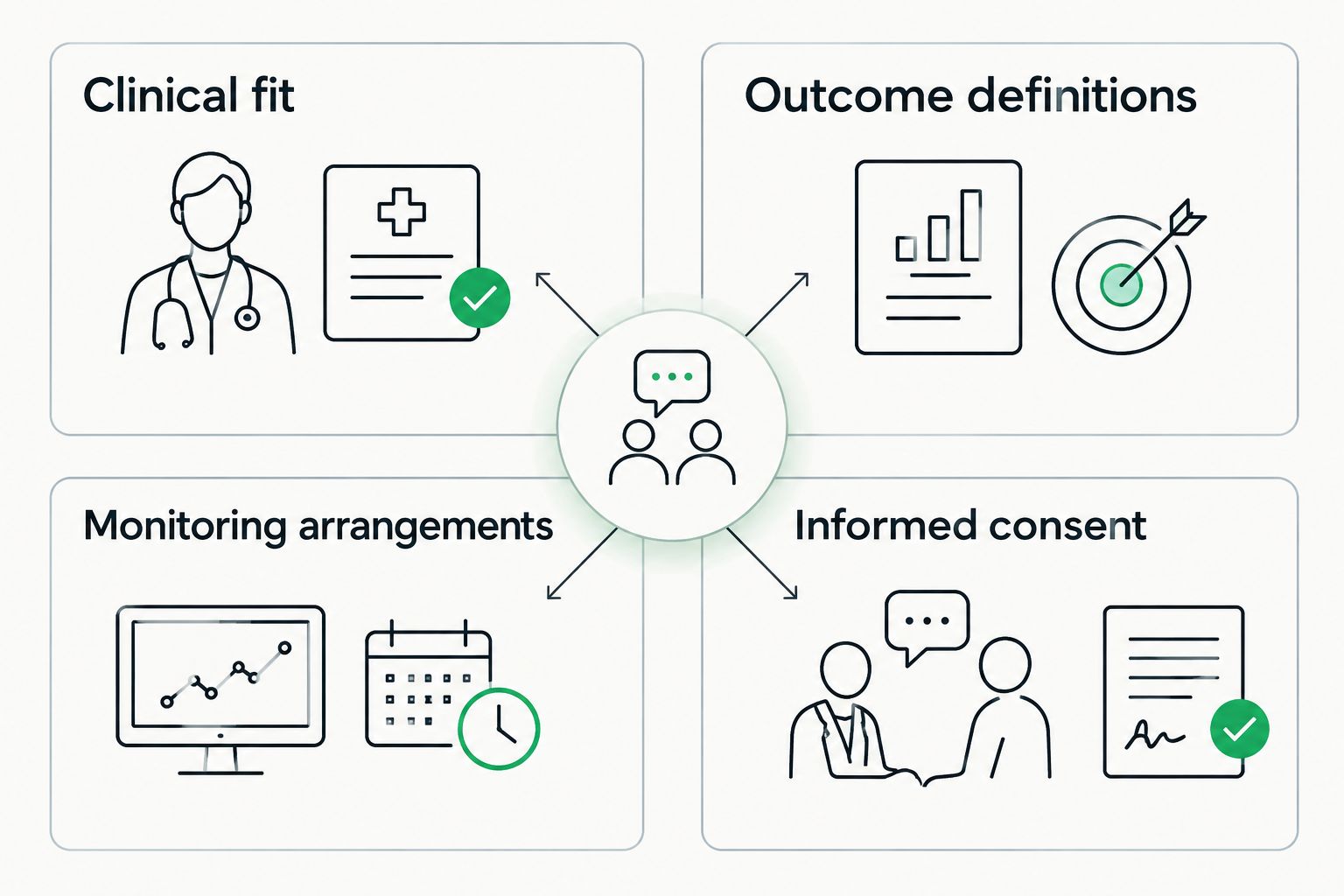
Clinical fit
Ask: What findings support this recommendation? Which investigations would change the plan? If another clinician has suggested something different, request an explanation of the difference without assuming either recommendation is automatically correct.
Outcome definitions
Ask whether quoted results refer to pregnancy or live birth, and whether they are calculated per cycle started, egg retrieval or embryo transfer. Request the reporting period and the relevant patient group.
Monitoring arrangements
Confirm where consultations, scans and procedures take place. Ask how instructions are communicated and whom you should contact if symptoms or medication questions arise.
Informed consent
Ask for the main risks, alternatives and reasons to reconsider the plan. You should understand what you are agreeing to before signing consent documents.
Keep a short written record after each appointment. Note the recommended next step, its clinical reason and any unanswered questions; this makes a second opinion more useful.
When should you seek a fertility assessment?
Established fertility-evaluation guidance recommends assessment after 12 months of regular unprotected intercourse when the female partner is younger than 35 years, or after 6 months at 35 years or older. Earlier evaluation is appropriate when there is a known concern, such as irregular periods or suspected reproductive problems.
These thresholds guide when to seek assessment. They do not mean you must wait despite symptoms, and they do not establish which treatment you need.
Bring previous reports and a record of relevant treatments or medicines. Where applicable, both partners’ histories and assessments matter; focusing only on one partner can leave important questions unanswered.
How the options are ranked
This guide places broad assessment before treatment-specific decisions. IUI, IVF, ICSI and PCOS-focused care then occupy different clinical-use slots rather than compete for a universal first place.
The criteria are clinical fit, clear alternatives, meaningful outcomes, monitoring arrangements, informed consent and practical access. A clinic’s suitability depends on how those criteria apply to you, not on a blanket “best” label.
Which fertility centre should you choose?
Choose a fertility centre that explains your next step clearly and can describe the arrangements for delivering it. For patients considering the services listed here, Neo Fertility belongs on the consultation shortlist—not as a promise of a particular outcome.
Before booking, contact the clinic to confirm the consultation location and what records to bring. Keep the first decision narrow: choose an assessment you understand, not a treatment you have not yet discussed.
FAQ
What is the best fertility centre in Jeevanbhimanagar Bangalore?
The best fertility centre is one whose clinical assessment, proposed treatment and care arrangements fit your circumstances. Neo Fertility offers IVF, IUI, ICSI, egg freezing and PCOS care to patients in Marathahalli and Whitefield; confirm the consultation location before booking.
Does Neo Fertility have a clinic in Jeevanbhimanagar?
Confirm the clinic address directly before travelling. Neo Fertility’s stated service areas are Marathahalli and Whitefield, which should not be treated as confirmation of a Jeevanbhimanagar branch.
Is IUI better than IVF for a first treatment?
IUI is not automatically better than IVF as a first treatment. The choice depends on the assessment, including relevant ovulation, tubal and semen findings, and the clinician’s reasons for recommending either pathway.
Is ICSI the same treatment as IVF?
ICSI is a fertilisation technique used within IVF. It involves injecting a sperm directly into an egg rather than relying on conventional insemination of eggs in the laboratory.
Does PCOS mean I need IVF?
PCOS does not automatically mean you need IVF. An assessment should consider ovulation, your pregnancy goals and other relevant fertility factors before recommending treatment.
When should I see a fertility specialist?
Seek assessment after 12 months of trying when the female partner is younger than 35 years, or after 6 months at 35 years or older. Seek advice earlier when there are irregular periods, known fertility concerns or other relevant symptoms.
What should I ask about a fertility clinic’s success rate?
Ask which outcome the figure measures, which patients it includes and how it is calculated. Also request the reporting period and whether the denominator is cycles started, egg retrievals or embryo transfers.
One last thing
For your 2026 consultation, ask: “What finding would make you change this treatment plan?” The answer helps you understand whether the recommendation is tied to your clinical situation and where reassessment belongs.
Use this guide to prepare questions, not to diagnose yourself or select a procedure without individual medical advice.