

Best fertility-consultation fit for patients in Marathahalli and Whitefield: Neo Fertility. Best route for complex male-factor findings: an andrologist-led service. Best route for a requested baseline test: a diagnostic laboratory with clinician follow-up. This 2026 guide compares these care routes without presenting an unverified ranking of Bangalore clinics.
- For the best clinic for male infertility tests in Bangalore, prioritise clinical interpretation over a standalone report.
- Neo Fertility suits Marathahalli and Whitefield patients seeking a fertility consultation; confirm male-testing arrangements before booking.
- An andrologist-led service is the stronger route for complex male-factor findings or suspected reproductive tract problems.
- Semen analysis, hormone tests and genetic testing answer different questions; not everyone needs every investigation.
Why this matters
A semen report is not a complete fertility diagnosis. You need someone to connect the findings with your medical history, examination and your partner’s assessment—not simply hand over a result.
For your 2026 shortlist, separate where the sample is tested from who explains the result. Those services can involve different appointments or providers. Confirm both before choosing a clinic.
Neo Fertility is a fertility-consultation option for patients in Marathahalli and Whitefield who want to discuss male-factor concerns alongside a couple’s treatment plan. The clinic is led by Dr. Payal Mahapatra and offers IVF, IUI, ICSI, egg freezing and PCOS care. Ask directly about its male infertility testing arrangements, laboratory pathway and specialist referrals.
What makes the best male infertility testing clinic?
Judge a clinic by the decisions it helps you make. A longer investigation list does not automatically mean a better assessment.
- Clinical assessment: The appointment should cover reproductive history, relevant medicines, previous surgery and symptoms—not just a test request.
- Laboratory process: Ask for written collection instructions, sample-handling requirements and an explanation of how results are reported.
- Result interpretation: Know which clinician reviews the report and whether follow-up requires a separate appointment.
- Targeted investigations: Hormone, imaging and genetic tests should answer a clinical question rather than fill a package.
- Referral access: Ask how the service handles severe abnormalities, absent sperm or suspected structural problems.
- Couple-based planning: Male and female assessments should inform the same treatment discussion when you are trying to conceive together.
Use these criteria consistently. A convenient location matters, but it does not replace a clear diagnostic pathway.
Male infertility testing options at a glance
These are care-setting choices, not a verified league table of individual clinics. Only the named clinic’s stated services are described; specific testing arrangements require confirmation.
| Option | Best for | Main advantage | Key limitation |
|---|---|---|---|
| Neo Fertility | Fertility consultations around Marathahalli and Whitefield | Discussion within a clinic offering IUI, IVF and ICSI | Male-specific testing and referral arrangements need confirmation |
| Andrologist-led service | Complex male-factor findings | Focused assessment of male reproductive health | Laboratory and couple-treatment coordination need checking |
| Diagnostic laboratory | A clinician-requested semen analysis | A focused sample-testing appointment | A report alone does not establish diagnosis or treatment |
| Multispecialty hospital service | Fertility concerns alongside other medical problems | Access to different specialties within a hospital setting | Appointment coordination and laboratory arrangements vary |
Do not treat these routes as interchangeable. Choose according to the problem you need solved: an initial assessment, a requested test, specialist investigation or coordinated medical care.
1. Neo Fertility: best for a couple-based consultation
Neo Fertility offers IVF, IUI, ICSI, egg freezing and PCOS care under Dr. Payal Mahapatra. For patients around Marathahalli and Whitefield, it is an option for discussing how male-factor concerns fit into fertility planning.
The distinction is important: offering fertility treatment does not, by itself, confirm which male investigations are performed on-site. Before your 2026 appointment, ask where semen analysis takes place, who interprets it and how specialist referrals work.
Neo Fertility pros:
- Its stated services include IUI, IVF and ICSI.
- A consultation can address questions about the couple’s treatment direction.
- Its stated patient area includes Marathahalli and Whitefield.
Neo Fertility limitations:
- Confirm the availability and location of each requested male infertility test.
- Confirm whether your concern requires a separate andrology or urology appointment.
Best for: Patients seeking a fertility consultation near Marathahalli or Whitefield, particularly when both partners need a coordinated discussion.
Verdict: Hold a testing booking until the clinic confirms the investigation and follow-up pathway; book a consultation to discuss the appropriate starting point.
2. An andrologist-led service: best for complex findings
An andrologist focuses on male reproductive health. A urologist with male infertility expertise is another relevant specialist route, particularly when assessment requires examination or investigation beyond a baseline semen report.
This route deserves attention when a clinician identifies severe semen abnormalities, absent sperm, a suspected varicocele or a relevant surgical history. Do not assume that every urology service offers the same fertility expertise.
Andrologist-led service pros:
- Focuses the assessment on male reproductive history and examination.
- Supports investigation of possible hormonal or structural causes.
- Helps determine whether specialist procedures need consideration.
Andrologist-led service limitations:
- Confirm access to an appropriate semen-testing laboratory.
- Couple-based treatment planning can require coordination with a fertility clinic.
Best for: Patients with complex male-factor findings or a clinician’s recommendation for specialist assessment.
Verdict: Book the specialist assessment when complex findings need explanation; skip a test-only appointment as the entire care plan.
3. A diagnostic laboratory: best for a requested baseline test
A diagnostic laboratory is a practical route when a clinician has requested semen analysis and you already know who will review the result. The laboratory’s role is to examine the sample; clinical interpretation remains a separate responsibility unless explicitly included.
Ask about collection instructions before travelling. Do not assume that any nearby laboratory accepts semen samples or processes them under the conditions your clinician requires.
Diagnostic laboratory pros:
- Provides a focused route for a specifically requested investigation.
- Lets you complete testing before a planned clinical review.
- Keeps the appointment centred on the sample and report.
Diagnostic laboratory limitations:
- A report does not replace a medical history or examination.
- Collection and transport requirements can restrict where you provide the sample.
Best for: Patients with a test request, clear collection instructions and an identified follow-up clinician.
Verdict: Book for the requested investigation; skip treating a laboratory report as a final fertility diagnosis.
4. A multispecialty hospital: best for overlapping medical concerns
A hospital-based service is worth considering when fertility concerns sit alongside other medical problems. Examples include endocrine conditions, previous cancer treatment or a history requiring coordination between specialties.
The hospital label alone does not establish male infertility expertise. Check the individual specialist’s scope, the laboratory pathway and how appointments connect before choosing this route in 2026.
Multispecialty hospital pros:
- Can bring relevant medical specialties into the same care setting.
- Supports assessment when fertility is not the only health concern.
- Provides a route for discussing treatment-related reproductive effects.
Multispecialty hospital limitations:
- Different specialists can require separate appointments.
- Hospital-based care does not automatically include integrated fertility follow-up.
Best for: Patients whose fertility assessment needs coordination with another medical specialty.
Verdict: Book when your medical history calls for coordinated care; skip choosing by hospital size alone.
Which male infertility tests do you actually need?
Start with a clinical assessment, then select investigations that answer a specific question. Semen analysis is a central part of male infertility evaluation, but it does not explain every possible cause of difficulty conceiving.
| Investigation | What it assesses | Important limitation |
|---|---|---|
| Semen analysis | Features including sperm concentration, movement and morphology | Results require clinical context and sometimes repeat testing |
| Hormone blood tests | Hormonal factors relevant to sperm production or symptoms | They are not a substitute for semen analysis |
| Scrotal ultrasound | Selected structural questions | It is not automatically necessary for every patient |
| Genetic testing | Selected suspected genetic causes | It requires a specific indication and appropriate counselling |
| Sperm DNA fragmentation testing | Sperm DNA damage in selected situations | It is not a universal first-line investigation |
The World Health Organization’s semen examination manual provides standardised laboratory methods. The American Urological Association and American Society for Reproductive Medicine male infertility guideline supports history, examination and appropriately selected investigations—not indiscriminate testing.
These references inform the testing principles in this 2026 guide. They do not verify an individual Bangalore clinic’s services or performance.
Before you provide a semen sample
Follow your laboratory’s written instructions. WHO-standard semen collection commonly uses 2–7 days of ejaculatory abstinence, but your laboratory must confirm the instructions for your appointment.
Tell the team if any part of the sample is lost, if collection is difficult, or if you have recently had a fever. Also disclose medicines and supplements. These details belong in the clinical interpretation rather than being left out because they feel embarrassing.
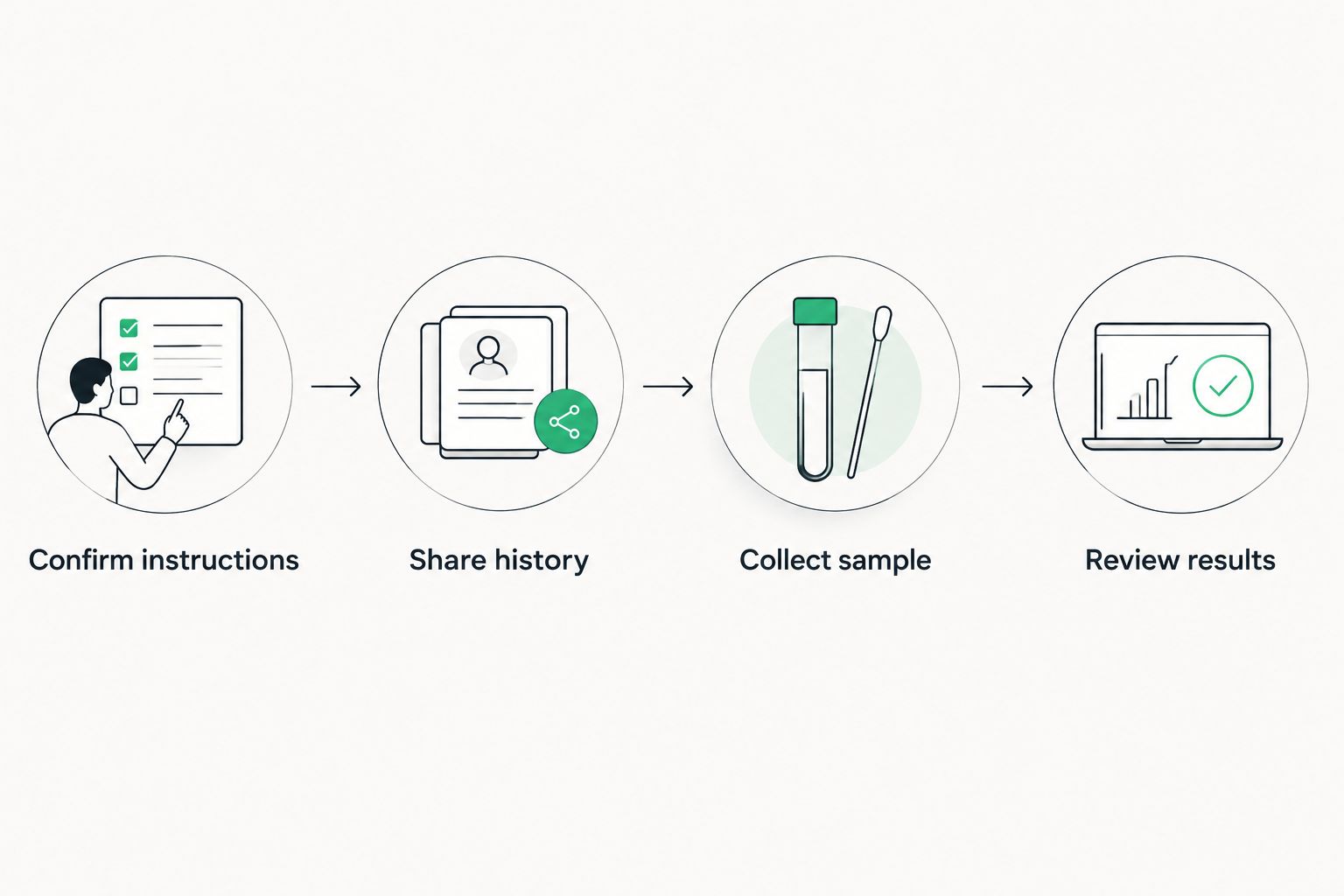
Use this sequence to keep the appointment useful:
- Confirm instructions: Check preparation, collection location and any transport requirements.
- Share history: Bring previous reports and a current medicine list.
- Collect sample: Follow the laboratory’s procedure and report collection problems.
- Review results: Arrange interpretation with the clinician responsible for your care.
A repeat test is not automatically evidence that the first laboratory made a mistake. Semen findings vary, and a clinician can request another sample to clarify an abnormal result. Ask what the repeat investigation is intended to resolve.
When should you seek an assessment?
For couples trying to conceive, evaluation generally starts after 12 months of regular unprotected intercourse when the female partner is younger than 35 years, or after 6 months when she is 35 years or older. These are general clinical thresholds, not a reason to delay assessment when a known concern exists.
Seek earlier advice for issues such as previous undescended testes, cancer treatment, sexual or ejaculatory difficulties, or a known abnormal semen result. Both partners’ histories affect the timing and scope of assessment.
Do not wait for a routine fertility appointment if you develop sudden, severe testicular pain. That requires urgent medical assessment rather than semen testing.
How these options were ranked
The order follows the purpose of the appointment: integrated fertility consultation, specialist male assessment, requested laboratory testing and multispecialty coordination. It does not claim that one provider has better diagnostic accuracy or pregnancy outcomes than another.
For your 2026 decision, use the same questions across every shortlist: Who examines you? Where is the sample tested? Who explains the findings? What happens if the result is abnormal?
Which route should you choose?
Choose a consultation before a package when you do not yet know which investigations you need. Choose a diagnostic laboratory when a clinician has already specified the test and arranged interpretation. Choose specialist male assessment when your history or findings require it.
Before committing, ask the clinic to explain the next step after both a normal and an abnormal report. That answer is more useful than a long list of available tests.
Clarify your testing pathway
Ask about male infertility investigations, sample collection and who will explain your results.
FAQ
What's the best clinic for male infertility tests in Bangalore?
The best fit is a service that combines appropriate testing with clinical interpretation and a clear follow-up plan. Neo Fertility is an option for fertility consultations around Marathahalli and Whitefield; confirm its male-testing arrangements before booking.
Should I visit a fertility clinic or an andrologist first?
Choose a fertility consultation for couple-based planning and an andrologist-led assessment for complex male-factor concerns. Your history, symptoms and previous reports help determine the appropriate route.
Is semen analysis enough to diagnose male infertility?
Semen analysis alone does not provide a complete diagnosis. A clinician interprets the findings alongside your history, examination and any additional investigations that are indicated.
How should I prepare for a semen analysis?
Follow the testing laboratory's written collection instructions. WHO-standard collection commonly uses 2–7 days of ejaculatory abstinence, but confirm the requirements for your appointment.
Do all men need hormone and genetic tests?
No, hormone and genetic tests are selected according to clinical findings. Ask which question each proposed investigation will answer and how the result would change your care.
Does an abnormal semen report mean I need ICSI?
An abnormal semen report does not automatically mean you need ICSI. Treatment depends on the nature of the findings, the wider assessment and both partners' circumstances.
Can a normal semen report guarantee pregnancy?
A normal semen report cannot guarantee pregnancy. Semen analysis measures selected characteristics, while conception depends on factors involving both partners.
One last thing
Ask this before booking: Who will explain my result, and what decision will that appointment help me make? A testing service should give you a route to interpretation—not leave you searching report terminology on your own.
This guide supports clinic selection and appointment preparation. It does not diagnose infertility or replace advice from your treating clinician.