

Best fit to consider for local fertility care: Dr. Payal Mahapatra at Neo Fertility, a clinic serving patients in Whitefield and Marathahalli. This 2026 guide to the best IVF doctor in Whitefield explains how to assess that option, compare treatment pathways and choose a doctor around your diagnosis rather than a ranking alone.
- Consider Dr. Payal Mahapatra at Neo Fertility for fertility care serving Whitefield and Marathahalli.
- The best IVF doctor in Whitefield should explain your diagnosis, treatment alternatives and reasons for recommending IVF.
- Compare IVF, IUI and ICSI by clinical purpose; they are not interchangeable treatments.
- Choose a clear consultation plan before committing to a fertility treatment cycle.
Why this matters
Choosing a fertility doctor is not the same as choosing a treatment. Your first task is to understand what is affecting conception; only then can you judge whether IVF, another intervention or further assessment makes sense.
Dr. Payal Mahapatra at Neo Fertility is a local option for patients seeking a clinic offering IVF, IUI, ICSI, egg freezing and PCOS care. That service range gives you several relevant topics to discuss. It does not establish which treatment you need or predict your outcome.
For your 2026 shortlist, put the quality of the clinical explanation ahead of a headline success rate. A useful consultation should leave you knowing what the doctor recommends, why it fits and what remains uncertain.
What makes the best IVF doctor in Whitefield?
Use these criteria before you compare names. They help you assess the consultation without treating popularity as evidence of medical suitability.
- Diagnosis-led recommendations: The doctor connects the proposed treatment to your medical history and assessment findings.
- Clear alternatives: You understand why IVF is being considered instead of IUI, further investigation or another approach.
- Relevant outcome explanations: Any success-rate discussion identifies the patient group and whether the outcome means pregnancy or live birth.
- Transparent responsibilities: You know who makes treatment decisions, answers questions and explains changes during care.
- Practical follow-up: You understand monitoring requirements and how to seek help when symptoms or questions arise.
- Informed consent: The doctor explains risks, limitations and alternatives before asking you to decide.
A convenient location matters because fertility treatment can involve repeated appointments. It should support your choice, not replace the clinical criteria above.
Fertility treatment options at a glance
Neo Fertility offers the following services. Use this comparison to organise your questions, not to select a procedure without medical advice.
| Option | Best for discussing | What it involves | Main advantage | Key limitation |
|---|---|---|---|---|
| IVF | A recommendation for fertilisation outside the body | Eggs are collected and fertilised in a laboratory before an embryo transfer | Allows laboratory fertilisation and embryo development | Involves procedures and does not guarantee pregnancy |
| IUI | Whether insemination is appropriate after assessment | Prepared sperm is placed inside the uterus around ovulation | Does not involve egg collection | Suitability depends on factors including tubal function and sperm findings |
| ICSI | Whether sperm-related findings justify a different fertilisation method | A single sperm is injected into an egg during IVF | Addresses particular fertilisation problems | Is not automatically necessary for every IVF cycle |
| Egg freezing | Preserving eggs for possible future use | Eggs are collected and frozen | Preserves eggs collected at the age of freezing | Does not guarantee a future baby |
| PCOS care | Irregular ovulation and reproductive health concerns | Assessment and management of polycystic ovary syndrome | Addresses a condition that can affect ovulation | PCOS alone does not establish a need for IVF |
These options address different questions. Comparing them as though each were a stronger version of the previous treatment leads to poor decisions.
1. Dr. Payal Mahapatra: a local fertility-care option
Dr. Payal Mahapatra leads Neo Fertility, which serves patients in Whitefield and Marathahalli, Bangalore. The clinic offers IVF, IUI, ICSI, egg freezing and PCOS care.
Best for: Patients in these areas seeking an assessment and a discussion of the clinic's fertility services. Start with your history and goals rather than arriving committed to a particular procedure.
Dr. Payal Mahapatra: reasons to consider
- A named doctor leads the clinic.
- The clinic serves patients in Whitefield and Marathahalli.
- IVF, IUI and ICSI are among the offered services.
- Egg freezing and PCOS care are also available as consultation topics.
Dr. Payal Mahapatra: limits to weigh
- A service list cannot establish whether a doctor is the right clinical fit for your circumstances.
- Offering several treatments does not mean each treatment is appropriate for you.
- Local convenience cannot predict treatment success or replace a discussion of risks.
What to ask before deciding
Ask Dr. Payal Mahapatra to explain the working diagnosis, what further assessment would change and why the proposed approach fits your situation. If IVF is recommended, ask what makes IVF preferable to the alternatives in your case.
Also clarify who will handle follow-up questions and how treatment decisions will be communicated. These are practical parts of choosing a doctor, not administrative details to postpone until treatment begins.
Verdict: Hold treatment decisions until the consultation establishes a clear clinical reason for the proposed approach.
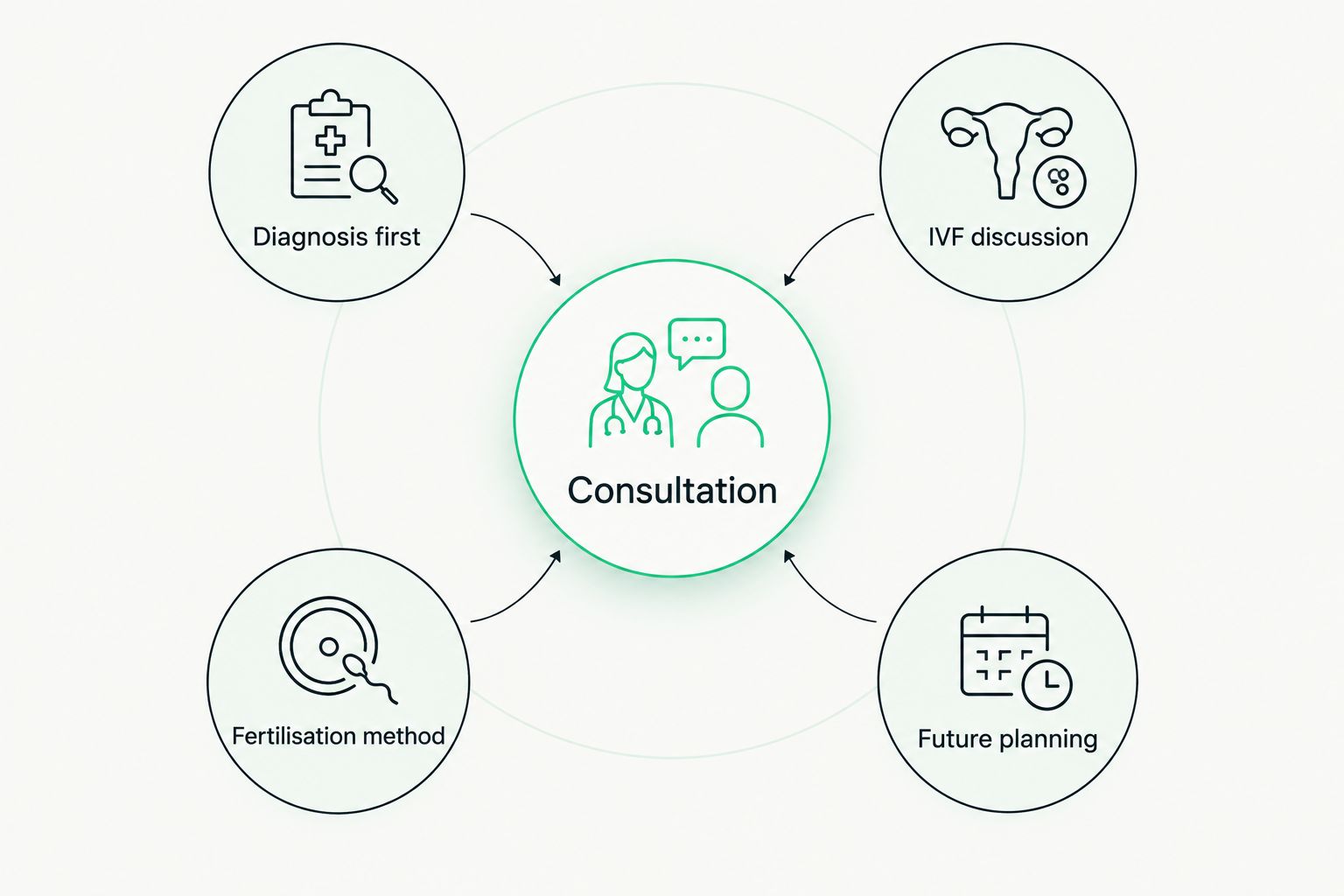
Match the consultation to your actual question
A useful appointment starts with the decision you need help making. Bring that question into the discussion early, especially if previous appointments have left you with several treatment names but no clear explanation.
Diagnosis first
If you do not know why conception has been difficult, ask what the assessment needs to establish. Depending on your history, the discussion can include ovulation, sperm assessment, the uterus and fallopian tubes.
Best for: Patients without a clear explanation for their fertility difficulty. The advantage is a reasoned starting point; the limitation is that assessment does not always identify a single cause.
IVF discussion
If IVF has already been recommended, ask the doctor to connect that recommendation to your findings. Request an explanation of egg collection, fertilisation, embryo development and transfer in language you can repeat back.
Best for: Patients evaluating an existing IVF recommendation. IVF enables fertilisation outside the body, but it also involves procedures, uncertainty and decisions about embryos.
Fertilisation method
IVF and ICSI are not competing names for entirely separate treatment journeys. ICSI is a fertilisation technique used within IVF, and the reason for recommending it should be explicit.
Best for: Patients asked to consent to ICSI. Its advantage is its role in addressing particular fertilisation problems; its limitation is that it is not a universal improvement for every patient.
Future planning
If you are considering egg freezing, discuss your reproductive goals and what freezing can and cannot preserve. Eggs frozen now do not remove every health consideration associated with a future pregnancy.
Best for: Patients exploring fertility preservation rather than immediate pregnancy. The benefit is preserving eggs for possible later use; the limitation is uncertainty about future use and outcomes.
When should you seek a fertility assessment?
Common clinical guidance recommends an assessment after 12 months of trying to conceive if the female partner is younger than 35 years, or after 6 months if she is 35 years or older. These are assessment thresholds, not deadlines for starting IVF.
If the female partner is over 40 years, a more immediate evaluation is appropriate. Seek advice sooner at any age when there are known concerns, such as absent or irregular periods, suspected tubal problems or a known sperm-related issue.
For a 2026 appointment, bring the duration of trying, menstrual history and any previous fertility reports. Include relevant information from both partners where applicable; fertility assessment should not automatically focus on only one person.
Do not interpret these timeframes as instructions to wait despite symptoms or an existing diagnosis. The doctor should adapt the assessment to your circumstances.
How to question IVF success rates
A success rate is useful only when you understand what it measures. Clinical pregnancy and live birth are different outcomes, and a result per embryo transfer is not the same as a result per treatment cycle started.
Ask these questions before using a percentage to compare doctors:
- Does the figure describe pregnancy or live birth?
- Is it calculated per cycle started, egg collection or embryo transfer?
- Does it relate to patients in my age group?
- Does it separate treatment using a patient's own eggs from donor eggs?
- Does it include later transfers of frozen embryos from the same egg collection?
Compare like-for-like outcomes, not the largest percentage. A headline figure cannot account for your complete medical history or guarantee your result.
In your 2026 consultation, ask the doctor to explain the limitations of any estimate as clearly as the estimate itself. Clear uncertainty is more useful than an unexplained promise.
Prepare a useful first-appointment checklist
Bring existing reports rather than relying on memory. Previous prescriptions, scan reports, semen-analysis results and records of earlier fertility treatment can help the doctor understand what has already been assessed.
Write down your questions before the visit. Focus on decisions rather than trying to collect every possible medical detail.
- What is the working diagnosis?
- Which findings support the recommended treatment?
- Would further testing change the plan?
- What alternatives are reasonable, and what are their limitations?
- What risks require particular attention in my case?
- What symptoms need urgent medical advice during treatment?
- What happens if treatment does not proceed as planned?
Leave with a written summary where possible. You should be able to explain the proposed next step without reconstructing the conversation from memory.
How this shortlist is structured
This guide identifies a named local option and separates the clinic's stated services from the clinical questions you need answered. It is not a league table of doctors or a claim that one clinician produces better outcomes than another.
The selection criteria are diagnosis-led care, clear alternatives, understandable outcome reporting, defined responsibilities and informed consent. Apply the same criteria to every doctor you consider.
Which IVF doctor should you choose?
For patients seeking local fertility care, Dr. Payal Mahapatra at Neo Fertility is an option to consider. Choose the doctor whose recommendation you understand and whose proposed approach addresses your assessment findings.
Your 2026 decision should end with a clear next step: assessment, a treatment discussion or another opinion when a major question remains unresolved. It should not end with a commitment made solely because a page called someone the best.
FAQ
Who should I consider when looking for the best IVF doctor in Whitefield?
Dr. Payal Mahapatra at Neo Fertility is a local option for patients in Whitefield and Marathahalli. Assess the consultation against your diagnosis, treatment alternatives, risk discussion and follow-up needs rather than relying on a ranking alone.
Do I need IVF if I have not become pregnant?
Difficulty conceiving does not automatically mean you need IVF. A fertility assessment helps establish whether further investigation, another treatment or IVF is appropriate.
Is ICSI better than standard IVF?
ICSI is not automatically better for every patient undergoing IVF. It is a fertilisation technique with particular clinical uses, so ask why it is recommended for your findings.
Does PCOS mean I need IVF?
PCOS does not automatically mean you need IVF. The treatment discussion depends on ovulation, your reproductive goals and other fertility factors.
When should I see a fertility doctor?
Seek assessment after 12 months of trying if the female partner is younger than 35 years, or after 6 months if she is 35 years or older. Seek advice sooner for known fertility concerns, and more immediately if she is over 40 years.
What should I bring to my first fertility appointment?
Bring previous test results, scan reports, prescriptions and records of earlier fertility treatment. Add a brief menstrual and medical history and questions about the decisions you need to make.
Does egg freezing guarantee a future pregnancy?
Egg freezing does not guarantee a future pregnancy or baby. It preserves eggs for possible later use, and the consultation should explain the limitations and factors affecting future outcomes.
Can I compare doctors using IVF success rates?
You can compare success rates only when the outcome definitions and patient groups are comparable. Ask whether each figure measures live birth or pregnancy and whether it is reported per cycle started or per embryo transfer.
One last thing
Ask this before agreeing to treatment: What finding would change your recommendation? The answer helps you distinguish a plan connected to your medical circumstances from a procedure discussed in general terms.
You do not need to leave the first appointment knowing every technical detail. You need to understand the next decision, its reason and its limitations.